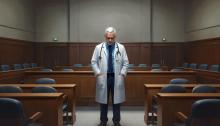
The doctor accused of negligence leading to the death of Balkhash resident Meruert Aulbayeva escaped punishment. On 6 November 2025, two years after the tragedy, the statute of limitations for criminal prosecution expired.
This was reported by the deceased's brother, Aitbek Aulbayev.
It all began in July 2023, when Meruert first went to Balkhash hospital with severe pain and a high fever. On 24 July, she was refused hospital admission. Two days later, she returned — her condition had worsened — but doctors again sent her home.
Only on 27 July did an ultrasound with a private specialist reveal a purulent growth almost eight centimetres in size. With such a diagnosis, surgery should be performed within two hours. Instead, the doctors chose a watch-and-wait approach.
The operation was only performed on 3 August. It was carried out by the very head of surgery at Balkhash City Hospital who was subsequently charged. After the operation, Meruert was discharged, despite having a fever.
By early October, sepsis had developed. On 4 October, an emergency repeat operation was required — doctors discovered an abscess. Two weeks later, a third operation was performed: the intestine had to be removed in sections. It was only in November that Balkhash doctors contacted the regional hospital, but by then time had been lost.
On 4 November, a surgeon from another city performed a fourth operation. Two days later, Meruert died from multiple organ failure (the simultaneous failure of two or more vital organs).
A forensic medical examination established a direct link between the doctors' actions and the patient's death. Furthermore, it emerged that after the woman's death, more than 200 changes had been made to her electronic medical record. A posthumous diagnosis of Crohn's disease appeared, which experts deemed unjustified.
The investigation dragged on for a year and a half. According to Aitbek Aulbayev, he encountered obstacles at every turn: he was not recognised as a victim for a long time, they could not find the investigator, and the case was transferred between authorities for months.
When the materials reached court in April 2025, new delays began. The accused doctor himself was hospitalised — in the same hospital where he continued to work and where Meruert died.
Meanwhile, the National Scientific Medical Centre in Astana, where the accused underwent planned surgery, confirmed that the doctor's condition allowed him to participate in the proceedings, yet the court was suspended.
The hospital management, according to relatives, openly promised to help the defendant. The family's lawyer, Ibrahim Saduakasov, pointed to a conflict of interest: the accused works at the very site of the tragedy, and colleagues are speaking in his defence.
And although in October the suspension of the case was deemed unfounded, on 6 November the two-year statute of limitations expired, and the case was closed on formal grounds.
In the end, no one was held responsible for the death of Meruert Aulbayeva. Yet the family of the deceased is left with the feeling that the system did everything to ensure exactly that outcome.
The investigation, which was supposed to establish the truth and restore justice, turned into a marathon of bureaucratic delays. And when the two years expired, the state simply put an end to it.
Was this a coincidence — or a deliberate tactic of stalling? There will be no answer. But this case showed that in our justice system, it is enough to wait a little, for guilt to dissolve in time.