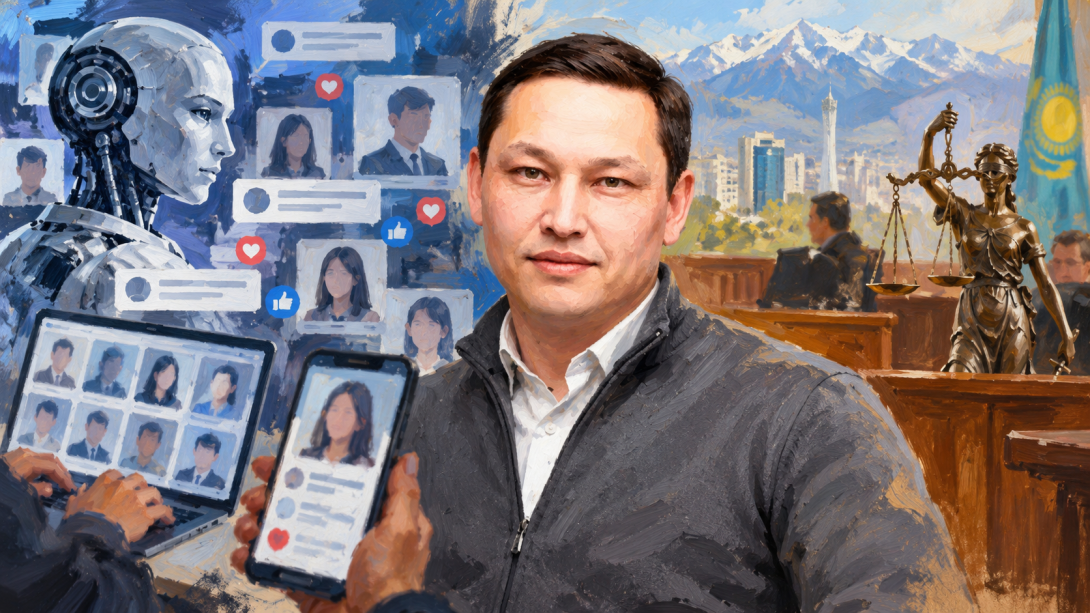
Artificial intelligence (AI) is penetrating ever deeper into everyday life — from manufacturing and software development to public services and the creative industries. However, the same technologies that make working with information easier also make it possible to create realistic fake images, imitate human communication and shape an artificial picture of public opinion.
Against the backdrop of the criminal case involving Kazakhstani public figure Sanzhar Bokayev, an information campaign using AI tools has unfolded on social media. This is no longer simply the usual internet spam, but technologies that make it possible to pass off artificially created activity as the reaction of real people.
THE SANZHAR BOKAYEV CASE: FROM PUBLIC ACTIVISM TO COURT PROCEEDINGS
On 16 October 2026, the Almalinsky District Court for Criminal Cases of Almaty began hearing the case of Sanzhar Bokayev, his nephew Madiyar Kalmenov and videographer Ulan Nusipkozha. The defendants are charged under Article 190 of the Criminal Code of the Republic of Kazakhstan (“Fraud”), Article 188 of the Criminal Code of the Republic of Kazakhstan (“Theft”), Article 218 of the Criminal Code of the Republic of Kazakhstan (“Legalisation of money or property obtained by criminal means”), Article 340 of the Criminal Code of the Republic of Kazakhstan (“Illegal felling of trees and shrubs”) and Article 274 of the Criminal Code of the Republic of Kazakhstan (“Dissemination of knowingly false information”).
Bokayev previously positioned himself as an independent analyst, blogger and defender of citizens' rights. In FRBK publications, his contacts with representatives of the former political and business elite were examined. He worked in the team of the former akim of Almaty and ex-head of the Samruk-Kazyna fund Akhmetshan Yessimov, and later found himself in the circle of Kairat Sharipbayev.
In 2015–2017, Bokayev worked within the structure of KazTransGas. According to the investigation, during this period he may have influenced the conclusion of a contract for organising a New Year corporate event worth more than KZT 100 million.
At the same time, he became widely known for his publications on contentious public issues, including the recycling levy, urban planning and the environment.
One of the episodes that caused a public outcry was a series of videos about granite slabs and tree felling in Baum Grove. According to the case materials, the filming may have been staged, and its purpose was to create public outcry and discredit the local authorities. A separate episode concerns the movement of more than KZT 42 million through the accounts of affiliated structures.
It was precisely against the backdrop of the court hearing that discussion intensified in the Kazakh internet, aimed at supporting Bokayev and creating the impression of his complete innocence. At the same time, the distinguishing feature of the current information campaign is the use of technologies that make it possible not merely to multiply messages, but to create a convincing imitation of independent user activity.
AI BOT FARMS: WHEN A DIGITAL PERSONA LOOKS LIKE A REAL PERSON
Previously, automated accounts often gave themselves away through empty profiles, the absence of personal photographs and dozens of identical comments. Generative artificial intelligence is changing this picture. Now a digital personality can acquire a realistic portrait, a posting history, everyday photographs and its own communication style within minutes.
On the social networks Instagram and Threads, accounts using images with characteristic signs of AI generation are taking part in the discussion of the Bokayev case. One such profile is hasan_k.7. Its image shows smoothed skin texture, distinctive facial symmetry, blurred background and characteristic colour rendering that point to the possible use of generative neural networks. A neural network logo is also visible in one of the videos.
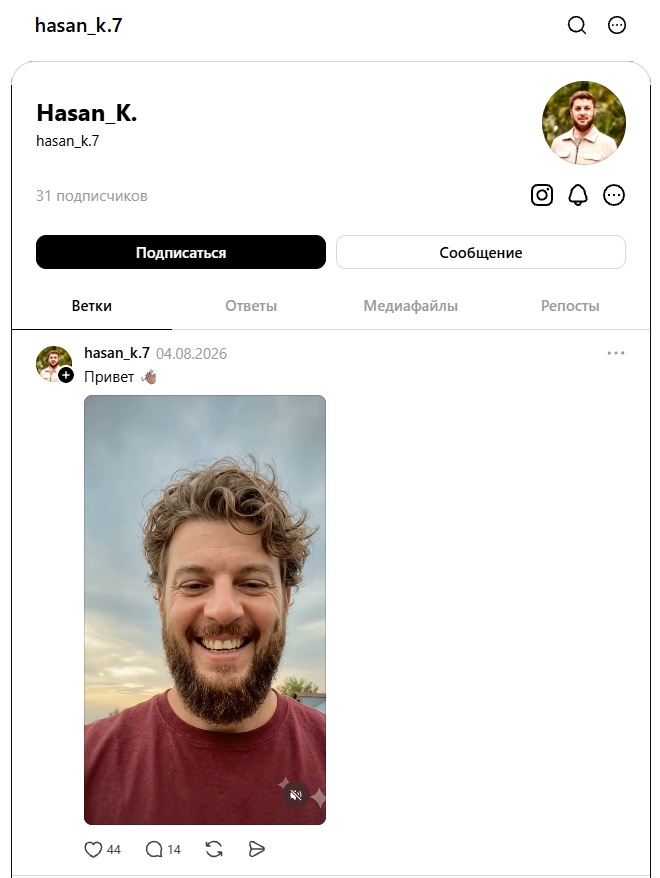
This approach makes it possible to create non-existent people who are outwardly indistinguishable from ordinary social media users. Instead of other people's photographs or standard images, bot farm operators can use generated avatars, building profiles with the appearance of everyday life.
But the visual component is not the whole story. Modern large language models (LLMs) are capable of creating comments with varied vocabulary, syntax and emotional tone. Messages may differ in form but boil down to a single task: to cast doubt on the investigation's arguments, discredit the judicial system and provoke an emotional reaction from the audience.
AI makes it possible to generate not only comments on the criminal case, but also short posts, greetings and photographs imitating ordinary user activity. As a result, a profile looks less like a technical tool for disseminating messages and more like the page of a person who has their own life and opinion.
The main difference of the new model is the ability to imitate not only a person, but also their public stance. When dozens of accounts express similar views in different words, artificial activity becomes less noticeable against the background of ordinary online communication.
HOW THE ILLUSION OF PUBLIC SUPPORT IS CREATED
The danger of AI manipulation lies in the fact that users assess public sentiment mainly by the posts and reactions available to them. If the same position appears repeatedly in comments, it may be perceived as the opinion of a significant part of society.
This is how the bandwagon effect arises: a person sees many outwardly independent reactions and begins to perceive their totality as an indicator of public consensus. If, however, some of the accounts are artificially created characters, the perception of the scale of support may turn out to be distorted.
In the context of the Bokayev case, this technology acquires particular significance. The court proceedings are accompanied by a public discussion in which various interpretations of what is happening compete. The use of AI to create realistic profiles and varied comments makes it possible to influence the perception of this discussion beyond the courtroom.
Instead of an open discussion of arguments, an imitation of a mass reaction may come to the fore. The genuine opinions of citizens risk being lost in the flow of artificially created messages, and social networks risk turning into a space where the visible number of supporters becomes a separate instrument of influence.
If content generation technologies are used for organised PR campaigns, pressure on public perception of a court process or the creation of an image of the unconditional innocence of its participants, then what is at stake is no longer merely a technological novelty, but also an ethical problem of the use of AI.
WHY ARTIFICIAL ACTIVITY DOES NOT REPLACE LEGAL ARGUMENTATION
A fundamental contradiction arises in the story surrounding Bokayev. Among the circumstances being examined in the criminal case are the alleged staging of video clips and the dissemination of false information. Against this backdrop, the use of generated characters to create artificial public support looks particularly telling: the very technology of imitating reality becomes an instrument for influencing the perception of events.
At the same time, a public campaign and court proceedings are subject to different rules. On social media, an effect can be created through the number of messages, emotional tone and the outward credibility of accounts. In court, what matters is evidence, testimony, expert opinions and the provisions of the law. One cannot replace the other.
Artificial profiles can create the impression of mass support, but they do not in themselves disprove the prosecution's evidence. Similarly, activity on social media does not establish the guilt of the defendants. Attempts to influence public perception do not change the procedural status of the case and do not predetermine the court's decision.
Moreover, image and text generation technologies are developing alongside tools for detecting artificial content. The characteristic features of images and the coordinated actions of multiple profiles are capable of drawing attention to possible coordination. As a result, an attempt to make a digital campaign convincing may end up revealing the mechanisms by which it works.
CONSEQUENCES: TRUST IN SOCIAL MEDIA UNDER THREAT
The spread of AI bot farms creates several long-term risks.
The first is the distortion of public discussion. Users lose the ability to reliably assess the prevalence of a particular position if some of the visible reactions are generated artificially.
The second is a decline in trust in digital communications. The more realistic fake profiles and images become, the harder it is to distinguish a real participant in a discussion from a character created by an algorithm.
The third is the use of content generation technologies in high-profile public and judicial stories. Tools originally intended for automation and creativity can turn into a means of manipulating the information agenda.
These risks go beyond a single criminal case. The ability to create digital characters and imitate a broad public response affects the very principle of public discussion: its participants must be able to understand whom they are interacting with and how faithfully real public reaction is being reflected.
EDITORIAL OPINION
The situation surrounding the Sanzhar Bokayev case demonstrates how important the question of the origin of digital content is becoming. When realistic avatars and varied comments are used to shape a particular public impression, social networks turn from a space for the exchange of opinions into a potential tool for managing perception.
However, neither the number of comments nor the persuasiveness of digital characters replaces legal argumentation. The charges brought against the defendants must be assessed by a court, and public discussion must not substitute for court proceedings.