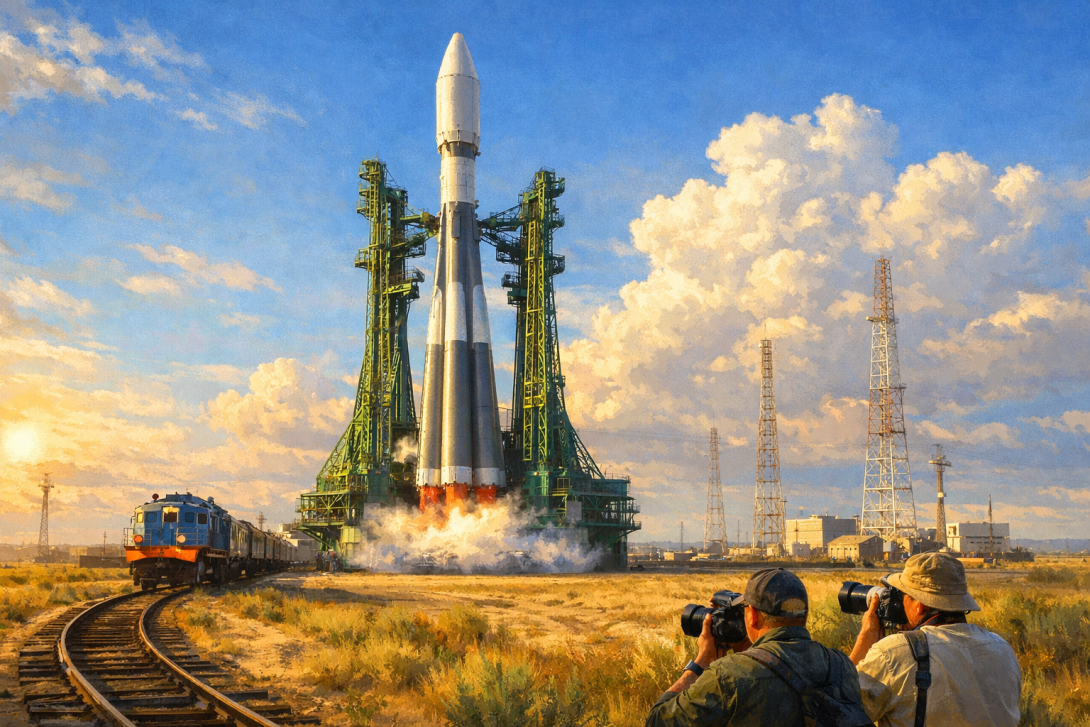
Twenty years of waiting, several delays and one failed tour for a "historic event" — and now the Soyuz-5 is finally standing vertically on the launch pad. The rocket, carrying a mock payload, was moved from the assembly and testing building at Site 42 along a railway line and installed on the launch pad at Site 45. The test launch is scheduled for 3 April 2026.
WHAT IS THE ROCKET
The Soyuz-5 is a two-stage medium-class rocket manufactured by the Russian JSC "Rocket and Space Centre "Progress". The rocket is also known by its project name "Irtysh" and its Kazakh name "Sunkar" ("Saker Falcon"). Its height ranges from 58.8 to 65.2 metres depending on the payload fairing (a protective casing at the top of the rocket that covers the satellite during launch), its diameter is 4.1 metres, and its launch mass is 526–531 tonnes.
The rocket can deliver 17.4 tonnes to low Earth orbit (close to Earth) and 2.5 tonnes to geostationary orbit (a very high orbit where the satellite "hovers" over one point on Earth). It uses naphthyl (a type of kerosene) and liquid oxygen as propellant — an environmentally friendly combination, unlike the toxic heptyl used in the Proton.
A HISTORY WITHOUT A DATE
The Baiterek project — a joint Kazakh-Russian initiative to build a launch complex at Baikonur — officially began in 2005 in the presence of the presidents of Kazakhstan and Russia. The path to the present day has been long: first, the Angara rocket was planned, then the site was changed twice, until it was decided to adapt the infrastructure left over from the Zenit rocket at Sites 42 and 45. The Soyuz-5 was developed specifically for this infrastructure.
In January 2026, the FBRK editorial team sent an official request to the Ministry of Artificial Intelligence and Digital Development — asking about the real timeline for the first launch. The ministry stated that the exact date would be set by the Kazakhstan-Russia Intergovernmental Commission only after the completion of the full testing cycle. By then, 81.3 billion tenge had already been spent from the total budget of 90.8 billion.
TOUR FOR THE LAUNCH THAT NEVER HAPPENED
The uncertainty surrounding the launch date did not stop people from making money off the anticipation. At the end of March, colleagues at PROTENGE discovered an Instagram advert for a tour called "Sunkar: The Birth of a New Era". Resourceful entrepreneurs were inviting people to become "witnesses to a real space event". The launch was promised for 27 March, and applications closed on 21 March. March ended, and the tourists, it seems, were left with nothing. A clear example of how unofficial "expectations" are monetised before real dates even appear.
WHAT NEXT
Now there is a date. The launch with a mock payload as part of flight tests has been scheduled for 3 April 2026 at 16:00 Astana time — a specific day, a specific time. If the tests go smoothly, Baiterek will move from the testing phase to actual commercial launches.
After twenty years of delays, changing concepts, and sold-out tours for an event that never happened, the Soyuz-5 stands on the launch pad with a firm date on the calendar. Now the main thing is that, on 3 April, the rocket really does lift off into the sky.