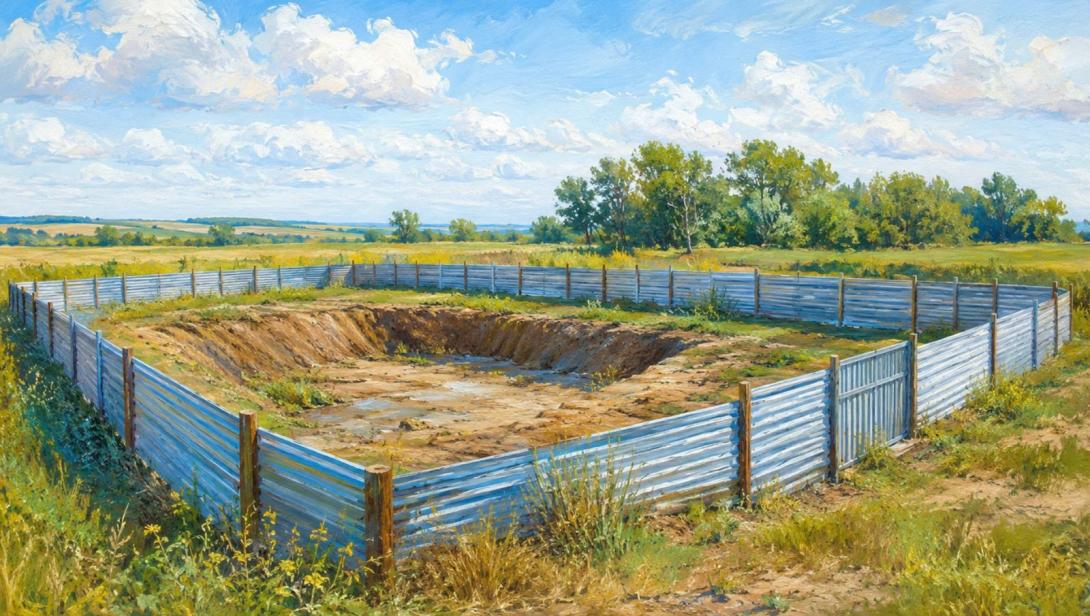
The Ethics Council of the North Kazakhstan Region (NKR) has recommended disciplinary action against the akims of four rural districts after discrepancies were found between the actual work completed and the project estimate documentation during the construction of livestock burial pits. An alternative to a warning of incomplete service compliance is dismissal.
WHAT WAS THE SUBJECT OF THE INVESTIGATION
According to Hronika.kz, the akims of the Roshchinsky, Sokolovsky, Kyzylzharsky and Asanovsky rural districts in 2025 entered into contracts with individual entrepreneurs (IEs) for the construction of livestock burial pits worth 6.8 million tenge each. The procurement was carried out using the single-source method.
After an inspection of the facilities by employees of the prosecutor's office of the Kyzylzhar district, discrepancies with the project estimate documentation were identified. In particular, instead of the project's planned fencing made of panels with bars and a spiral security barrier, the facilities were fitted with fences made of profiled sheeting.
Furthermore, the electric winches specified in the project were absent from the facilities. Despite this, the akims signed the certificates of work completion and paid the contractors the full cost of the work.
WHAT CONCLUSIONS THE INSPECTORS DREW
Chief Specialist of the Corruption Prevention Department Sultanbek Sakibayev reported that the actions of the rural district heads show signs of unlawful facilitation of business activities. The materials also state that the cost of the fencing specified in the project was 2,721,924 tenge, and the electric winch 157,956 tenge.
WHAT ARGUMENTS THE AKIMS PUT FORWARD
The akim of the Roshchinsky rural district, Ruslan Aitov, stated that he disagreed with the conclusions set out in the prosecutor's office's submission and the internal investigation materials. According to him, decisions were made based on the requirements of veterinary legislation, biological safety, and the need for the rational spending of budget funds.
He noted that, in his opinion, the project estimate documentation contained errors. Specifically, the mesh fencing specified in the project did not meet the requirements of the veterinary and sanitary rules approved by the Ministry of Agriculture. Therefore, solid fences made of profiled sheeting were installed instead. Also, according to Aitov, installing electric winches in places with no power lines was not practical.
The akim emphasised that the changes were documented in relevant protocols, and instead of the omitted elements, the contractors carried out other necessary work. According to him, no material damage was caused to the state.
WHY THE ETHICS COUNCIL MADE THIS DECISION
Members of the Council noted that issues of facility safety are important; however, in this case, the matter concerns compliance with established procedures. In the Council members' opinion, changes to the project should have been made officially, and payment for the work should have been made in strict accordance with the estimate documentation.
Following the meeting, the NKR Ethics Council recommended applying disciplinary action to the akims in the form of a warning of incomplete service compliance. A stricter alternative to this measure is dismissal.
CONTEXT AND SIGNIFICANCE
Issues regarding compliance with requirements for veterinary infrastructure facilities have previously been the subject of inspections in other regions of Kazakhstan.
Earlier, the Prosecutor's Office of the Akmola Region reported on violations in the Zerendinsky district, where 14 livestock burial pits did not meet veterinary requirements. In particular, the facilities lacked fencing, land plots were not formalised, and the property balance was not maintained. Following the inspections, the guilty officials were held disciplinarily and administratively liable.
Additionally, in October 2025, the environmental prosecutor's office of the Almaty region reported that in the region, 46 livestock burial pits had been operating for many years without mandatory environmental permits or monitoring of soil and groundwater conditions.