Co-founder and Executive Director of the Zertteu Research Institute fund, Sholpan Aitenova, compared the level of sports funding in Kazakhstan with the results of Kazakhstani athletes at the recent summer and winter games.
------------------------
For reference: the Zertteu Research Institute fund works to enhance the capacity of civil activists and develop tools to expand dialogue and influence budget decisions.
According to Ms Aitenova, since 1998 state budget spending on sport in Kazakhstan has increased 10 times, yet there has been no noticeable significant improvement in the country's results in Olympic sports.
The most successful Olympics for the country were London (2012) and Rio (2016), where the Kazakh team won 11 and 17 medals respectively, including thanks to athletes who trained in other countries. In 2012, state budget expenditure amounted to around 6.3 trillion tenge, and in 2016 - 9.4 trillion tenge.
For comparison, in 1996, Kazakhstan also won 11 medals, three of which were gold. The budget then was only 280 billion tenge.
In 2024, at the Paris Olympic Games, Kazakhstan won just 7 medals: three bronze, three silver, and one gold. And this with a budget of over 30 trillion tenge.
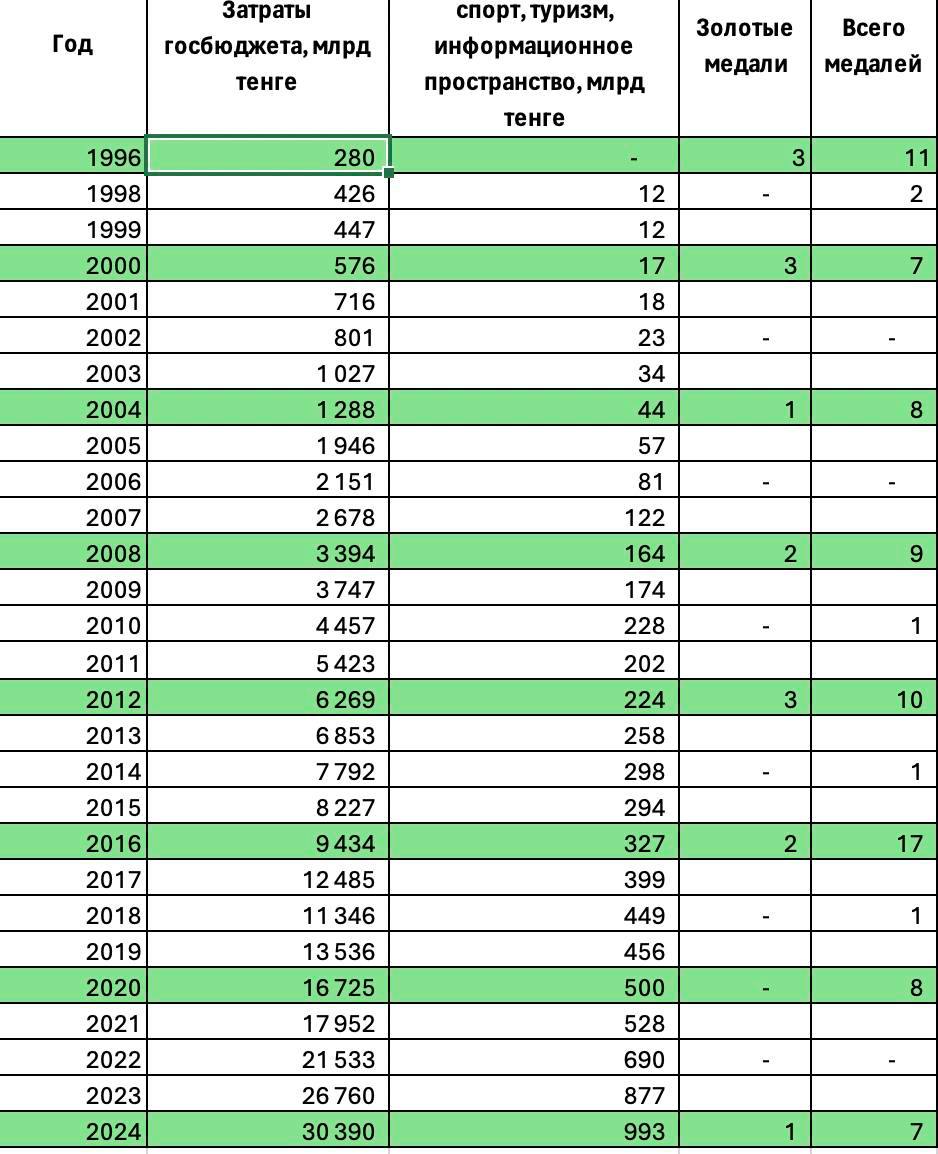
Sholpan Aitenova believes that this mismatch between funding and the final results of sports competitions is caused by the absence of a clear strategy for the development of mass participation and Olympic sport.
“We have significant funding for sport, but only isolated success stories on the international stage in futsal and tennis. Why is that? Because there are no clear priorities. Instead of funding professional football clubs from the budget, we should have been developing sports infrastructure for mass participation sport”, Ms Aitenova shared on her Facebook page.
Ms Aitenova notes that citizens fund mass participation and children's sport from their personal funds, while professional football clubs are supported via local budgets. There are, of course, also private investors.
Furthermore, in Kazakhstan situations often arise where there is a lack of infrastructure for holding sports competitions that meet international standards.
For example, a football team from Shymkent was forced to play a match in Almaty because the central stadium of the country's third largest city did not meet UEFA requirements.
From 2020 to 2024, the Sports Support Fund, for which Samruk-Kazyna JSC acts as the fund operator, spent 10 billion tenge on supporting Olympic sports.
However, in Ms Aitenova's opinion, spending on sport will be ineffective without a proper strategy for sports development and transparency in forming the country's sports budget.
“What needs to be done? Make all sports funding flows transparent (what is financed from the state budget and quasi-public sector), conduct an audit of all expenditures and identify weaknesses: how much we spend on naturalisation, excessive spending on team maintenance, and so on; audit sports infrastructure and its needs in the regions; analyse the need to fund professional football from local budgets”, concluded Sholpan Aitenova.