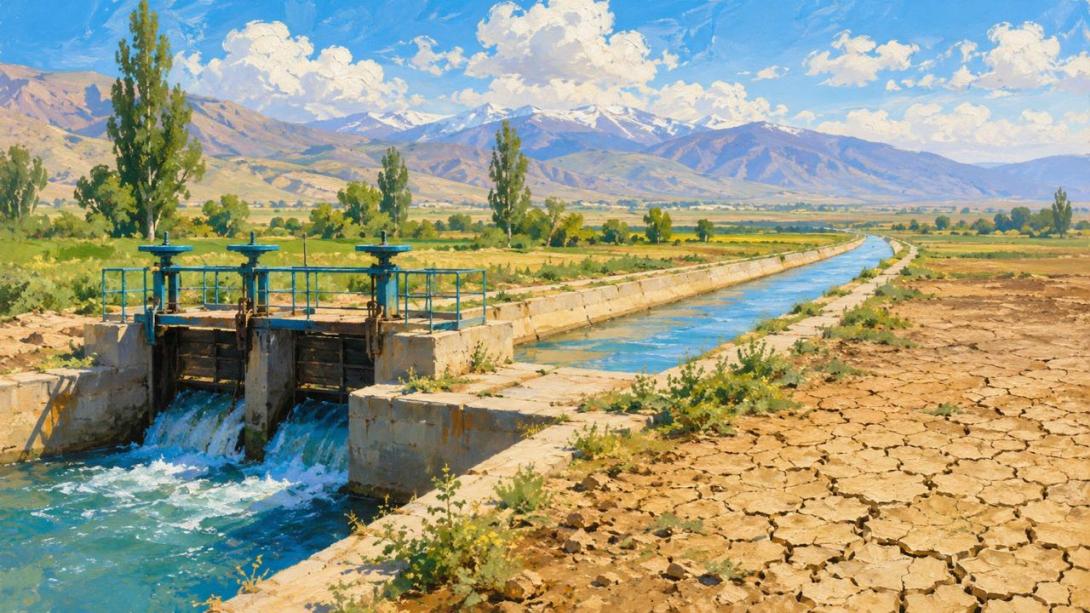
Digital tools of the Ministry of Water Resources and Irrigation of the Republic of Kazakhstan have "somewhere exactly" predicted the drought in the Zhambyl Region - this is how the Vice-Minister of Water Resources and Irrigation, Aslan Abdraimov, responded to a question from the founder of the FBK, Kirill Pavlov, regarding the poor filling of the Tasotkel Reservoir. The forecast did exist, but farmers in the region had been complaining about a shortage of irrigation water as early as April, that is, before the situation once again entered the public domain.
WHAT HAPPENED
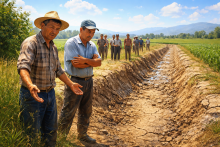
The Zhambyl Region is approximately 80% dependent on water coming from Kyrgyzstan. In April 2026, farmers of the Korday District were left without irrigation water right before the sowing season: RSE "Kazvodkhoz" refused to conclude a contract for water supply via the "Right Branch" canal, without explaining the reasons.
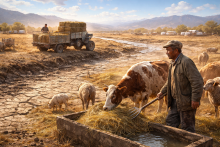
Farmers had already managed to purchase seeds and prepare the land, but switching to less water-intensive crops proved impossible, and the sowing dates were missed. According to data from the Zhambyl branch of "Kazvodkhoz", the restrictions could have affected about 1,000 farming enterprises in the region, and the water level in the Orto-Tokoi Reservoir in Kyrgyzstan was 100 million cubic metres less than the previous year's level.
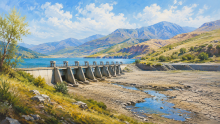
In May, the Minister of Water Resources, Nurzhan Nurzhigitov, at a government meeting confirmed the risk of a deficit in as many as four regions, including the Zhambyl Region. At that time, the filling of the Orto-Tokoi Reservoir stood at 83% - 79 million cubic metres less than a year earlier, and the Kirov Reservoir was at 78%, 89 million cubic metres less. The water consumption limit for the Shu-Talas Basin for 2026 was reduced from 1.2 billion to 900 million cubic metres.
WHAT THE VICE-MINISTER SAYS
At a recent briefing at the Central Communications Service (CCS) under the President of the Republic of Kazakhstan, dedicated to the implementation of measures for the digitalisation and automation of water resource management and accounting, FBK founder Kirill Pavlov reminded everyone of the issue of the poor filling of the Tasotkel Reservoir in the Zhambyl Region and the impending shortage of irrigation water there. The journalist asked whether this aligned with the ministry's forecasts.
Vice-Minister of Water Resources and Irrigation Aslan Abdraimov explained that the forecasting map is divided into two blocks: floods in the north of the country and drought in the south. According to him, the digital tools, referring primarily to the Tasqyn system, provided information on the drought and the situation with the Tasotkel reservoir, with the analytical centre personally preparing this data.
At the same time, the official emphasised that subsequent rainfall in May affected the situation, and that for a number of areas, the forecasts provided, as the department now assesses them, turned out to be "somewhere" accurate.
THE QUESTION THAT REMAINED UNANSWERED
From the Vice-Minister's words, it follows that his department had prior knowledge of the forecast regarding the risks of drought and insufficient filling of reservoirs in the south of the country. Moreover, both independent experts and representatives of the ministry itself had spoken publicly about the likely water shortage in the spring.
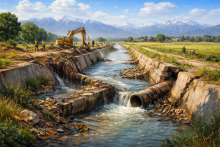
At the same time, in April, the Ministry of Water Resources reported large-scale water releases in the south of Kazakhstan in preparation for receiving flood waters. According to official data, the volume of such releases amounted to about 1 billion cubic metres.
If we assume that the ministry had prior knowledge of the forecasts regarding the risk of drought and water shortage in the south, and that at the same time the region was said to lack a high flood threat requiring such large-scale releases, then why were significant water releases from reservoirs carried out during this same period?
In this case, the key point is not so much the very existence of the forecast, but rather the managerial logic: how the risks (flood and drought) were balanced, and on the basis of what calculations were decisions made regarding releases and the subsequent filling of systems under conditions of an expected deficit.