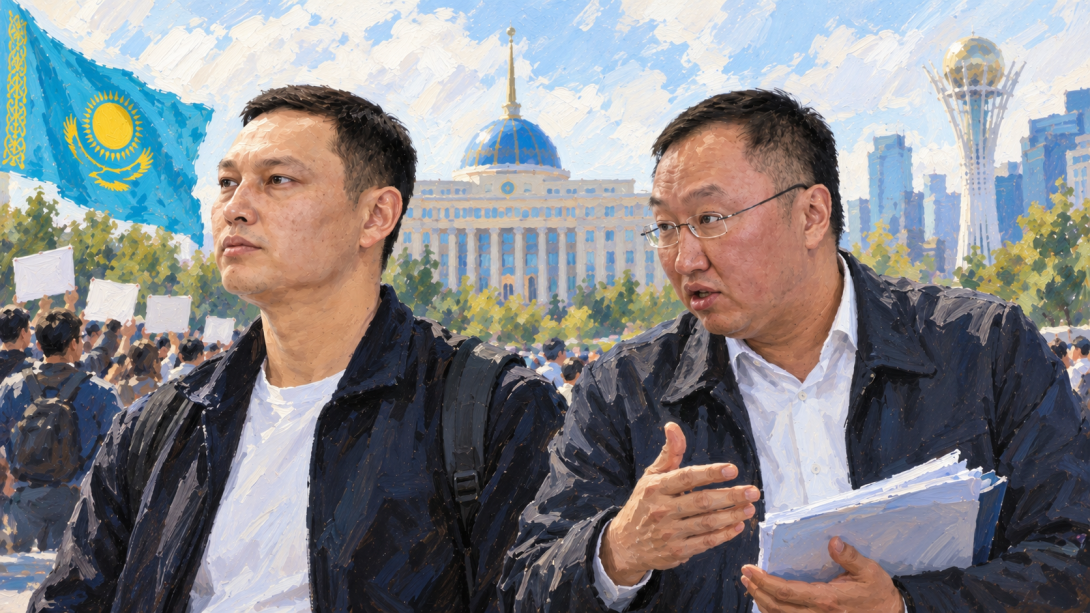
One of the co-founders of the “NetUtilSboru” movement, Vladimir Kim, has announced his departure from the group, stepped down as administrator, and ended his involvement in public activity. He took this decision after an incident at the border where, in his words, he unexpectedly encountered a temporary ban on leaving Kazakhstan.
WHY KIM DECIDED TO END HIS ACTIVISM
As Vladimir Kim reported on his page on Facebook, he decided to reconsider his further participation in public activity and “bring this chapter to a close for himself.”
At the same time, Kim announced his departure from the “NetUtilSboru” group, of which he had been one of the co-founders. He also stepped down from his role as group administrator.
According to Kim, he had been involved in the movement’s activities from the very beginning — since 21 December 2019.
WHAT HAPPENED AT THE BORDER
Vladimir Kim directly linked his decision to an incident that occurred while he was going through border control.
According to him, at the border he was informed that a ban on leaving Kazakhstan had been imposed on him. After border guards contacted Astana, the restriction was lifted roughly half an hour later, and Kim was permitted to leave the country.
He claims that the reasons for the ban were not explained to him. Kim stated that he has no debts or enforcement proceedings against him, no criminal cases have been opened against him, and he has never had access to state secrets.
FROM ITS ORIGINS TO A HIGH-PROFILE CAMPAIGN
The “NetUtilSboru” movement emerged against the backdrop of years of disputes surrounding the recycling levy system. Vladimir Kim was involved in its work from the moment it was founded and, together with other activists, became one of the campaign’s public faces.
The issue of the recycling levy in Kazakhstan united motorists and civic activists long before the most prominent campaign of 2024. The fight against this levy had been under way since 2019, when movement participants began publicly raising the issue.
The recycling levy is a mandatory payment associated with the production and import of vehicles and other machinery. Over the years, the main subjects of public disputes included the size of the levy, its impact on car prices, and how the resulting funds were used.
HOW BOKAYEV’S CAMPAIGN GATHERED 50,000 SIGNATURES
The movement gained its widest public recognition through the campaign against the recycling levy, one of whose leading figures was Sanjar Bokayev.
In 2024, a petition against the recycling levy was published on the state portal ePetition. It garnered more than 50,000 signatures, after which the matter was put forward for consideration by the government.
To discuss the petition, a working group was set up with representatives of state bodies, deputies, public associations, experts, and supporters of abolishing the recycling levy. However, further consideration was accompanied by disagreements between the campaign’s initiators and representatives of the Ministry of Industry and Construction.
In particular, Bokayev refused to take part in the working group’s first meeting following disputes over the rules for entering the ministry building. He also did not attend the subsequent public hearing in Almaty.
At the same time, the issue of the recycling levy itself continued to be a subject of public debate. In 2023, revenue from the recycling levy totalled more than 269 billion tenge, of which 238 billion tenge came from motor vehicles.
WHAT IS KNOWN ABOUT KIM’S POSITION ON THE BOKAYEV CASE
Following the detention of Sanjar Bokayev in the spring of 2026, Vladimir Kim remained one of the movement’s public representatives.
Together with other allies of Bokayev, he called for an open court process and a live broadcast of the trial. Kim also stated that he believed the criminal prosecution of Bokayev was politically motivated.
The investigation into Sanjar Bokayev’s case has now been completed. In September, his lawyers reported that the case materials had been handed over to the prosecutor.