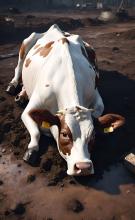
In various regions of Kazakhstan, burials of animals that died from anthrax remain that do not meet sanitary and biological requirements, and this situation persists today. This was reported by the Minister of Agriculture Aidarbek Saparov.
According to Cmn.kz, he stated that since 2024, the issue of eliminating such sites has been under the supervision of a special commission, which conducts visits to regions to inspect the burials and assess their sanitary condition.
"Veterinarians are keeping this issue under control. Mainly, in each region, there are about three or four burials. Special funding is allocated for this, sponsors are found, and work is being carried out," the minister noted.
It is noted that across the country, 340 burials have already been brought into compliance, while around 200 remain in the regions.
The editorial board of FBRK suggested as early as last spring that livestock burials that were flooded during the spring floods could pose a significant threat to Kazakh citizens. In this regard, we requested data from the Ministry of Agriculture (MoA) on the number of flooded anthrax burials.
Back then, in April, the department reported that across Kazakhstan as a whole, there were 10 flooded anthrax burials, noting that laboratory tests of samples from these burials yielded negative results and that there was no threat of an epidemic.
Later, in May, the MoA reported that 12 anthrax burials had now been flooded. These included 3 burials in Aktobe and West Kazakhstan Region, and 6 burials in North Kazakhstan Region.
The Ministry, as before, assured that there was no threat of an epidemic and noted that it was monitoring the epizootic situation in the country. The department stated at the time that active vaccination of animals against especially dangerous diseases was being carried out in the regions.
However, in August, due to an outbreak of anthrax in cattle, a quarantine was introduced in the village of Prirechnoye in the Denisovka District of Kostanay Region. Furthermore, there were rumours that meat from livestock that died during the floods was being ground into mince and sold at various catering outlets and markets. The Ministry of Agriculture denied this information.
In early September, in the rural district of Ulken Aksu in the Uyghur District of Almaty Region, a quarantine was introduced due to an anthrax outbreak. Four suspected cases of infection were recorded in the district. The preliminary cause of the disease was the involvement of local residents in the slaughter of a sick animal. Later, the number of infected individuals rose to 15 people.
In November, in Atyrau, a livestock market was closed and placed under quarantine due to the detection of anthrax in the carcass of a cow from the West Kazakhstan Region. Veterinary services tested the suspicious carcass four days after it was found. Later, a worker at the market tested positive for the cutaneous form of the disease.